


India’s heavy-duty EV story is finally real on the ground. Through late-2024 and 2025, OEMs moved from pilot slides to actual deliveries and purchase orders. The action is clustered in two buckets: 55-ton GCW electric prime movers for ports, minerals and steel corridors; and 14–19-ton GVW rigid trucks for city and short intercity freight. The headline reason fleets are leaning in: predictable routes with depot charging make the math workable, while new batteries and dual-gun fast-charging keep trucks turning. (electrive.com)
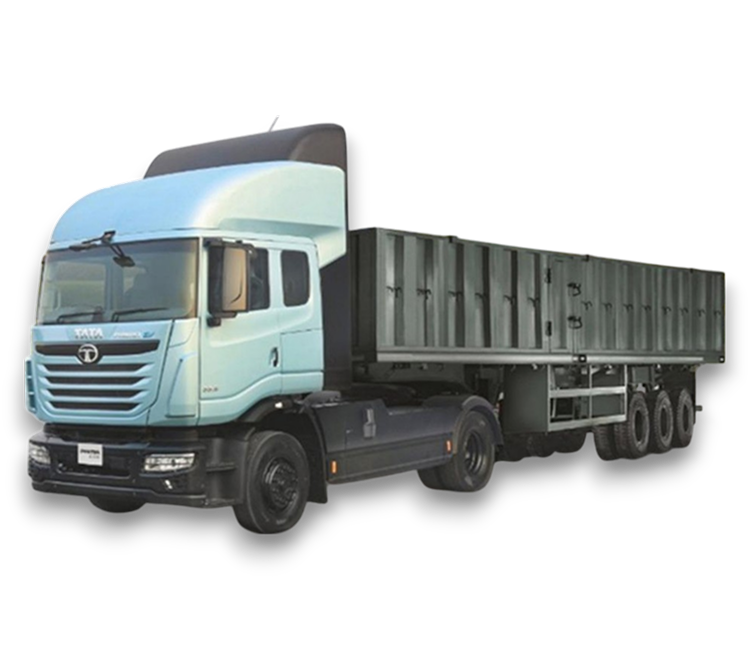
Let’s start with the big dog: Tata Prima E.55S. This is a 55-ton GCW electric tractor built for the heaviest Indian use-cases—cement, ports, steel and container moves. The drivetrain uses a 470 kW e-axle with LFP battery options of 300 kWh or 450 kWh, and the truck supports dual-gun CCS2 fast charging. Tata talks about a 200–350 km range depending on pack and duty cycle. In October 2025, Tata also began deliveries of the Prima E.55S to Enviiiro Wheels Mobility for mineral and ore haulage—so this is not just an expo prototype anymore. For a fleet, that combination (big packs, high power and dual-gun CCS2) means the truck can be scheduled on repeatable, high-mass lanes with planned charge windows. (electrive.com)
The second flagship is Ashok Leyland’s AVTR 55T Electric (4×2 tractor). It pairs a 220 kW motor with a 301 kWh battery and quotes up to ~180 km range—enough for fixed shuttle corridors, especially when the return leg brings the truck back to a yard charger. Leyland positions the packs at frame level to keep trailer compatibility and offers simultaneous dual-gun CCS2 to reduce pit-stop time. If your route is a predictable port–ICD loop or plant-to-yard move, the AVTR 55T sits right in the sweet spot for a first heavy-EV pilot. (electrive.com)
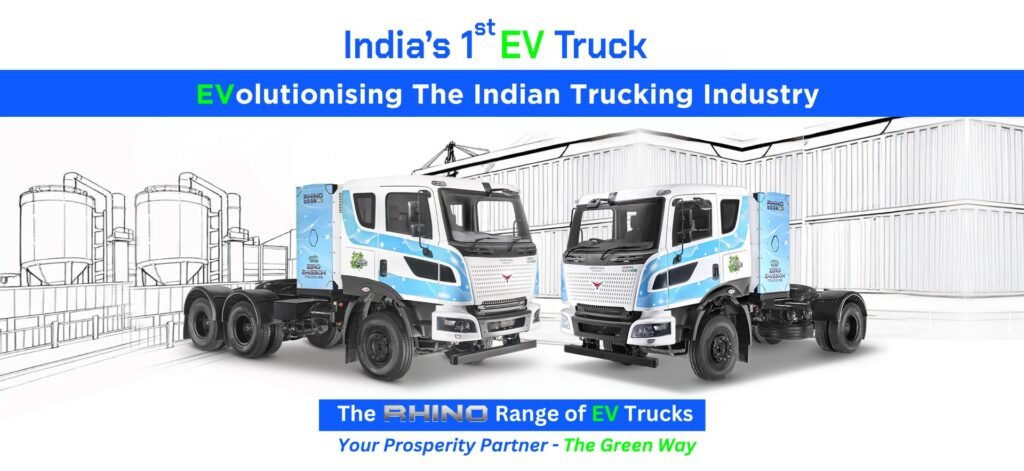
A strong new entrant is Montra Electric’s Rhino 5538 EV (4×2, 55-ton GCW) from the Murugappa Group. The Rhino uses a 282 kWh LFP battery with a 280 kW (380 hp) PMSM motor and 2,000 Nm torque. Key numbers you can put in a plan: ~189 km rated range under standard test conditions (one leg loaded, one empty) and fast charging from 20% to 100% in about 60 minutes. The spec leans into quick turnarounds in captive operations—think mine to railhead or port to CFS—where a single top-up per shift keeps the asset working. (Montra Electric Truck)
There’s also an emerging option from EKA Mobility. At Bharat Mobility 2025, EKA showed a 55-ton electric tractor-trailer with a 322 kWh LFP pack, dual-gun (up to ~240 kW) fast charging, and a claimed ~200 km range. As deployments begin, fleets will want to watch service coverage, parts availability and telematics integration—areas where staples like Tata and Leyland already have depth. Still, it’s a welcome sign that multiple local players are entering the 55T segment, which should help prices and innovation. (TruckDekho)
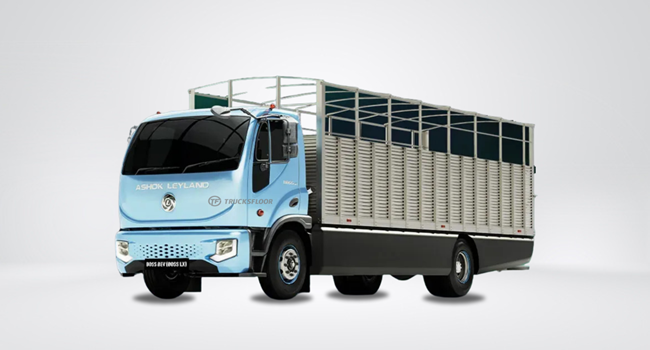
Now, not every “heavy” route in India needs a 55T tractor. Inside metros and on short intercity hops, rigid trucks dominate. Ashok Leyland’s BOSS Electric range is the mainstream choice here. The BOSS 14T EV (14,050 kg GVW) carries about 201 kWh of batteries and claims up to ~230 km range; the larger BOSS 19T EV uses the same ~201 kWh pack with a ~194 km claim. In practice, that translates to city FMCG/white-goods and building-materials runs where trucks leave a depot in the morning, make 2–3 consolidated trips, and return for overnight charging. If your operation is mid-mile or consolidation runs within a region, this class gives you the best mix of payload and daily range without the complexity of tractor–trailer yards. (electrive.com)
Batteries & chemistry. Most of these platforms are on LFP packs. LFP is heavier per kWh than NMC but wins on thermal stability, cycle life and cost—exactly what a high-utilisation fleet wants. The practical implication: you plan routes around energy rather than squeezing exotic chemistries. For Prima E.55S, the 300/450 kWh options let you choose between quicker charges and longer stints; Montra’s 282 kWh is set up for one charge window per shift; Leyland’s 301 kWh aims squarely at sub-200-km shuttles. (electrive.com)
Ton capacity and what it really means. For tractors like Prima E.55S, AVTR 55T, and Rhino 5538, the “ton” figure refers to GCW = 55,000 kg—that’s the combined weight of truck, trailer and cargo. For the BOSS rigids, the number is GVW (vehicle + payload). Why it matters: range claims are sensitive to what you tow and where. If you’re comparing spec sheets, always clarify whether the number is GCW or GVW and match it to your duty cycle. (electrive.com)
Range planning—how to think about it. OEMs quote certified or internal test ranges: Prima E.55S at 200–350 km (pack-dependent); AVTR 55T around 180 km; Rhino 5538 at ~189 km in a mixed load/empty test; BOSS 14T ~230 km and 19T ~194 km. Your real-world number depends on the trailer, average speed, gradients, ambient temperatures and how often you stop. The safe habit is to plan routes with buffers and align charge windows with natural layovers—shift changes, loading bays, port queues. (electrive.com)
Charging—why “dual-gun CCS2” shows up everywhere. For heavy trucks, two CCS2 connectors allow higher effective charge rates or sequential top-ups without moving the vehicle. Leyland’s AVTR 55T and Tata’s Prima E.55S both highlight dual-gun support; EKA 55T mentions dual-gun fast charging up to ~240 kW. In the Montra Rhino’s case, the maker quotes ~60 minutes from 20→100%, which is a useful rule-of-thumb for scheduling. If you’re designing a yard, think in terms of stalls, power availability (kW), and dwell times rather than only count of chargers. (electrive.com)
Who should pick what (simple guidance).
- Choose 55T tractors (Prima E.55S, AVTR 55T, Rhino 5538) if your business runs fixed, repeatable corridors—port ↔ ICD, plant ↔ yard, mine ↔ siding—where you can control charging at one or both ends. These trucks shine when you can standardise trailer drops and schedule a single mid-shift or end-shift charge. (electrive.com)
- Choose 14–19T rigids (BOSS Electric) if your freight is city or near-city with multiple drops and a nightly return to the depot. You’ll get simpler operations, fewer dependencies on trailer assets, and enough range headroom for a typical two-trip day. (electrive.com)
- Keep an eye on EKA 55T if you want more choice in the tractor space; early fleets should validate after-sales coverage and uptime guarantees before scaling. (TruckDekho)
Costs and the “more”. Heavy EVs promise lower energy and maintenance per km, but the system cost lives in charging and downtime. The recent Prima E.55S deliveries show how early adopters are deploying in sectors (minerals, ores) that already work in hub-based patterns—ideal for yard charging and planned turnarounds. When you budget, model (a) charge power you can actually draw at your site, (b) likely dwell times, (c) spare vehicles for unplanned downtime, and (d) tyre and brake wear (EV regen helps, but axle loads and routes still drive costs). (Tata Motors)
Bottom line. If you want an electric heavy truck in 2025 India, you can buy one today and put it to work—55T tractors for captive, high-mass lanes and 14–19T rigids for dense city freight. The Prima E.55S brings the largest battery choices and most power; AVTR 55T is a practical 180-km shuttle specialist with dual-gun CCS2; Rhino 5538 leans on quick 60-minute charges and a clear 189-km test figure; BOSS 14/19 EV covers metro logistics with 200-ish-km claims and well-known service backing. Match the truck to the duty cycle, plan your yard power, and you’ll get the economics these platforms were built to deliver. (electrive.com)Sources: Tata Prima E.55S specs & Jan-2025 showcase; AVTR 55T/ BOSS 14T & 19T specs and delivery note; Montra Rhino 5538 official page; EKA 55T unveil with battery, range and dual-gun details; and Tata’s Oct-2025 press release on the first Prima E.55S deliveries. (electrive.com)